Revealing the co-occurrence patterns of public emotions from social media data
Mar 11, 2026·,,,,,,,·
0 min read
Yang Hua
Sijin Li
Wufan Zhao
Jizhe Xia
Haoran Wang
Yang Chen
Liyang Xiong
Guoan Tang
 co-occurrence patterns of public emotions
Abstract
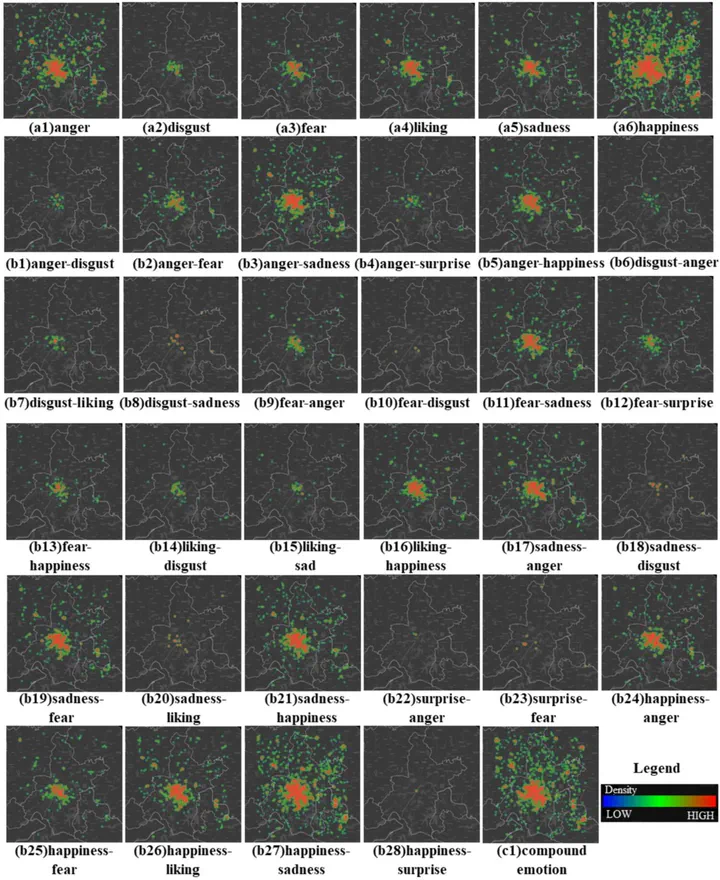
Perceiving multidimensional emotions from social media data and analyzing their spatiotemporal dynamics constitute a significant topic at the intersection of geographic information science and social management. However, existing methods often oversimplify emotions by neglecting mixed categories, providing representations of spatiotemporal emotion patterns with limited accuracy, and overlooking the influence of environmental factors on emotions. To address this issue, we proposed a framework that integrates the deep learning model with co-occurrence theory to classify individual emotions into single, dominant-subordinate, and compound classes. Emotional graphs and metrics were leveraged to characterize the spatiotemporal distribution of public emotions. The proposed method identified 34 types of complex emotions and revealed that urban environmental factors, such as building volume and night-time light intensity, were closely associated with variations in emotional distribution and dynamics. Compared with valence-based classification methods, the proposed method clearly illustrated the changes in public emotions following a respiratory infectious disease outbreak and subsequent health control measures. Uncertainty analysis conducted for grid- and street-based spatial units demonstrated the robust stability and cross-scale consistency of this method. This study provides deeper insights into collective emotion patterns and their geographic drivers, offering a valuable reference for urban governance and emergency management.
Type
Publication
International Journal of Geographical Information Science