Pop-HSTM: a multi-scale coupled framework for dynamic population modeling

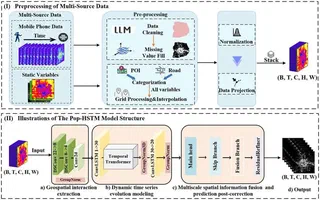 Overall framework of Pop-HSTM for dynamic population prediction.
Abstract
Predicting fine-grained population distributions over time remains challenging because observational proxies are heterogeneous and indirect, and human mobility involves coupled spatial and temporal processes. Existing methods often insufficiently represent multi-scale spatial constraints, especially the interaction between large-scale urban structures and local neighborhood processes. To address this gap, this study proposes Pop-HSTM, a global-local coupled deep learning framework for dynamic population prediction. Pop-HSTM integrates local spatial interaction learning, temporal dependency modeling, and cross-scale spatial fusion to jointly represent neighborhood-level interactions and broader mobility patterns. Using mobile phone data and multi-source geospatial covariates in Beijing, Pop-HSTM outperforms selected state-of-the-art baselines, reducing prediction errors by approximately 20–40%. It also maintains stable performance under extended prediction horizons of up to 96 h and limited historical observations. The results suggest that explicitly coupling global spatial structure with local interactions can improve fine-grained dynamic population modeling and provide a useful framework for spatiotemporal prediction in GIS.
Type
Publication
International Journal of Geographical Information Science
