Revealing the co-occurrence patterns of public emotions from social media data
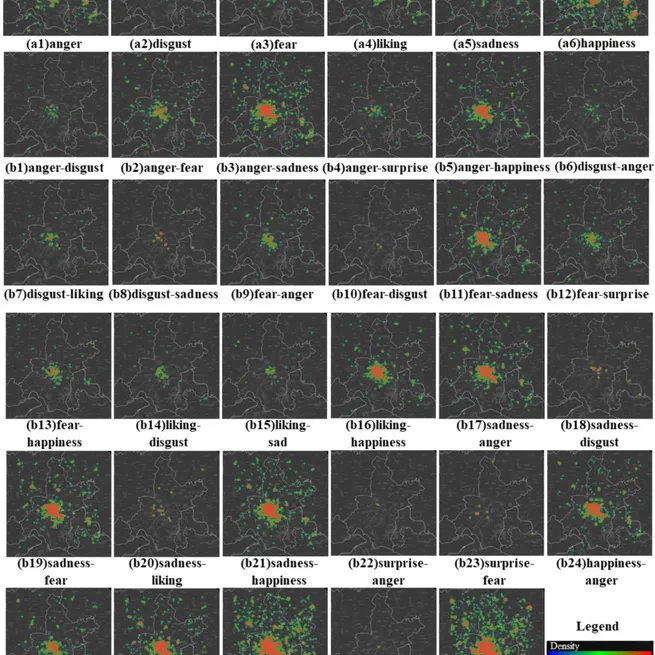
This study proposes a framework that integrates deep learning with co-occurrence theory to classify public emotions from social media data into single, dominant-subordinate, and compound classes. The method identifies 34 types of complex emotions and reveals associations between urban environmental factors and emotional distribution. Compared to valence-based methods, it effectively captures changes in public emotions following a respiratory infectious disease outbreak, demonstrating robust stability across spatial scales.
Mar 11, 2026
Deep learning detects entire multiple-size lunar craters driven by elevation data and topographic knowledge
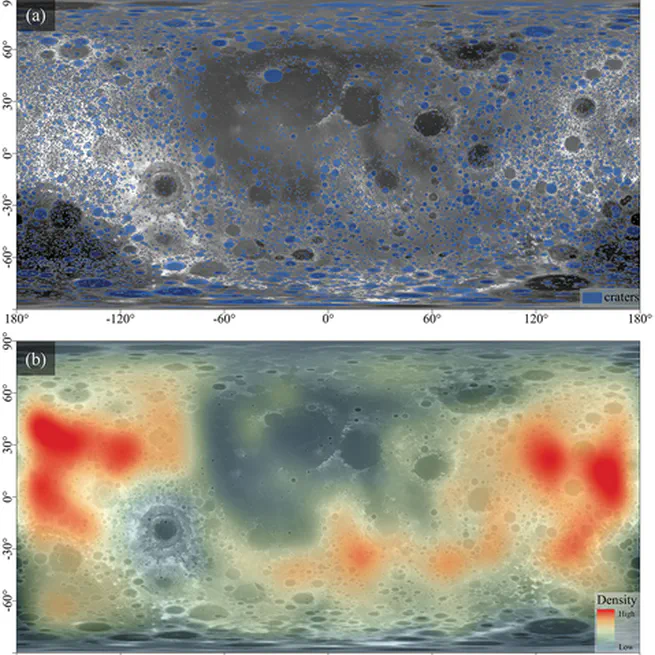
Lunar craters are important geomorphological features, that provide valuable insights into lunar morphology, geology, and impact processes. However, the current understanding of lunar craters of different sizes, especially smaller craters (diameter <5 km), is still incomplete. The lack of understanding of small lunar craters affects our understanding of the lunar surface and its geological history. Therefore, in this study, we propose a deep learning Crater Detection Algorithms (CDA), called Lunar Topographic Knowledge Attention U-Net (LTKAU-Net) that integrates a Digital Elevation Model (DEM) and topographic knowledge.
Feb 7, 2025